
Evidence
Using lack of evidence as the starting point for a theory for which there is evidence


Epistemology is one of my favorite subjects because it is central to my own theory of the evolution of perception. It will be clear how it relates as we go on.
Textbooks often define epistemology as “the theory of knowledge.” This is ridiculous, because there is no theory of knowledge. Plato once defined knowledge as “true justified belief,” and that was for a long time called the theory of knowledge. But to say knowledge is justified true belief only describes what knowledge would be if we had it, but it tells us nothing about when we know a belief is absolutely justified. What would justify our saying a belief was certain? I should be clear that we are talking about absolute certainty here when referring to something being “knowledge.” A guess or a hunch or a probable claim are not what we mean here by knowledge. Here we are referring to certainty, or what we could call “proven” beyond all possible doubt. That is the kind of “knowledge” a theory of knowledge is looking for.
Philosophers today agree that there is no current theory of knowledge.
Epistemology is the study of the question, how do we know if something is true, and is certainty even possible? So we could call it the study of knowledge.
In this essay we are going to cover the many ways that people seek to justify belief and talk about the problem of obtaining certainty.
In our daily lives we are constantly doing epistemology. Anytime we ask how we know something, evaluate the reliability of a source, or separate fact from fiction, we are engaging in epistemology. When someone tells us something or when we read something online, we frequently find ourselves wondering who to believe.
People often get into arguments over what to believe when they are faced with conflicting narratives. One source tries to convince us of X. Another insists just as strongly that X is absolutely false.
And this is made more complicated by the fact that the world is full of various types of liars. Some people are literally paid to lie to promote some belief to create a certain outcome, such as getting people to purchase a product or vote for a certain candidate. And there are also pathological liars who believe their own lies and even pass lie detector tests.
Lying and coping with liars is such a common part of the human experience that “Thou shalt not bear false witness” is one of the Ten Commandments. This is why we have a person place his hand on a Bible before testifying in court or taking an oath of office. And yet they still lie.
And there are certain people who confabulate. This means they don’t intend to lie, but fabricate imaginary experiences as compensation for loss of memory.
Courts
This problem makes separating fact from fiction a major part of the legal procedure. There is an art of cross examination. And there are many sorts of evidence that can be entered to “build a case.” What we call “best evidence,” a term used in law, is that evidence which convinces the greatest number. And so a jury is selected to hear and consider all the testimony and evidence and render their “opinion.” So, for all the effort of our justice system, which is honest effort at least in principle, at the end of the day what is “true” is a subjective judgment.
Historians
Historians also develop best practices for determining what actually took place in the past, and separate truth from legend. These include careful methods of reasoning to consider evidence carefully and divide fact from fiction. And yet, even among the finest scholars differences of opinion do exist, and new evidence or a new interpretation of evidence frequently can incite revision of belief. Again, even a consensus view among historians amounts to an opinion.
Science
People today are often conditioned to think the “scientific method” can determine any truth, and establish absolute certainty. This view about science has a name. It’s called “scientism.” However, such a view of science does not conform to the reality about how science actually works. The actual scientific method goes roughly like this:
A new observation is made.
A question is asked, usually dealing with its cause, about that observation.
A hypothesis is proposed.
An experiment is conceived and carried out to test the hypothesis.
If the hypothesis appears to be corroborated by the results of the experiment, and this is repeated many times by other scientists, the status of the hypothesis is elevated to theory.
Science, conducted using the scientific method, never assigns a status of “fact.”
Why not?
The reason is that someone at any time in the future may come along with a new proposed explanation for the same observation, and a new experiment to test it. Science is then confronted with the problem of choosing between multiple theories for the same phenomenon.
Science in general does not want to make the same mistake that religions made in the past, of holding dogmatically to a belief, even when competing views arise. Aristotle’s geocentric theory (the theory that the sun and planets orbit the Earth) was the accepted cosmological model for nearly 2,000 years. Even when Nicolaus Copernicus introduced the heliocentric model in 1543, placing the sun at the center of the solar system, the Catholic Church resisted the change for another hundred years.
And today, numerous theories taught in physics classes get challenged. If you hear a person say any of the following, know there is some agenda behind it, for such statements do not comport with real science.
“It’s settled science.” The fact that science is never “settled” is what separates it from religion.
“99% of scientists agree.” Consensus of opinion is not proof something is true, and citing it as proof is a well established fallacy in informal logic called the “bandwagon fallacy.”
Therefore, real science is always satisfied with a degree of uncertainty.
Logic in Science
Many people assume science uses logic. They do, but not the way people think. It’s important to know the kind of logic science uses, how it uses it, and why it cannot be used to claim certainty.
There are four kinds of logic. Two are considered formal logic. We’ll discuss the other two briefly as well.
Deduction.
Deductive logic is always valid, meaning a properly formulated deductive argument can never be faulted for its reasoning. And yet, its conclusion can be 100% false. Let me explain.
If all men are mortal
And, if Socrates is a man
Then, it follows that Socrates is mortal
This is true as far as it goes. If the first premise is true, and the second premise is also true, then the conclusion has to be true. But this is solely by virtue of the arrangement of the words. That the conclusion is valid so long as the premises are true doesn’t tell you if the premises are true. The conclusion is only as true as the premises. But is it known for sure Socrates was a man? He might have been made up by Plato, and some people have proposed he was.
Deductive logic can’t tell you anything you didn’t already think, and it can’t tell you if something you think is true. So, deductive logic is useless in science, except to speak clearly. It amounts to ‘garbage in; garbage out.’ If you arrive thinking X and you use deductive logic you’ll leave thinking X.
Induction
Induction is the principle that if something tended to happen in the past, it is likely to repeat in the future. So, that things fall at a certain speed from a particular height above the Earth can be assumed to continue in the future, for it has always been observed to occur in the past. Therefore, we call it a “law.” Science definitely does use inductive logic all the time. In fact, science is based primarily on induction. Although as we will see it also uses a form called abduction, explained below.
The problem is, induction can never tell us what causes any law to recur. For this we are left only with theories. We can show that such and such regularly occurs as it does, but not why.
Informal Logic
There are also two forms of logic besides formal logic. The first of these are the informal fallacies, collectively called informal logic. These are simply determined by common sense. An example is the fallacy of saying something is untrue simply because the person who said it was flawed in some irrelevant way. This is called “ad hominem.” Obviously, reasonable scientists try to be aware of and avoid informal fallacies as much as possible.
Abduction
The final form of logic is abduction. Abduction is a form of reasoning that starts with an observation or incomplete set of facts and then seeks the simplest, most likely explanation for them. This is a fancy way of saying that one makes an “educated guess.” Scientists heavily rely on abduction to form hypotheses. The problem is that abduction is only guessing, however educated, and there is room for future alternative guesses. The problem then again becomes choosing between alternative guesses, and this is rarely as simple as it would first seem.
Didn’t Get the Memo
So, summarizing what we’ve covered, the problem of determining what is true is one for which there is no known solution. We simply cannot know things for certain, given the methods we have. There is always room for uncertainty, even in law, scholarly fields like history, and in science.
But now, let’s leave aside professional fields of inquiry, where even the most concerted efforts to find reliable ways to discern fact from fiction are fallible. Consider how hard it is for ordinary people in everyday life to discern between competing narratives they hear concerning products, theories in medicine, politicians, and advocates for all manner of things. Many people can’t even site the forms of logic described above. They are often forced to choose what to believe on the basis of fitting in with certain social groups, or following what is most momentarily fashionable to believe. Most think science is more infallible than it is, or, even worse, realizing it is fallible fall for some new pseudoscience with just as much zeal.
And what is surprising is that in spite of this difficulty in determining truth, most feel sure their own beliefs are “known” and “proven.” So much so, that someone who tells them an alternative they aren’t familiar with may seem crazy. Didn’t they get the “fact” memo that we all did?
So, then when I come to people with a short book about an alternative explanation for how we came to experience the things we do around us — The Evolution of Perception — what are they to make of that? Most assume that whatever it is I’m talking about, the “scientists” or the “professional philosophers” at the “ivy league colleges,” or the “governmental agencies” must know all this, and have solved it long ago. They must think, “Poor Mr. Ott. He didn’t get the memo.”
Best Evidence vs. No Evidence
So, now it should be clear that no evidence is proof. There is only “best evidence,” and what that is is determined by the number convinced by it. So a talented charismatic conman can prove his case more easily than an honest man.
Now we have talked about cases where there is at least evidence. And in many cases there is even good strong evidence.
But, what are we to make of cases where there is zero evidence? The theory of the evolution of perception is deeply concerned with these. That is why I spent these pages covering the limitation of good evidence. To adduce a fact is to cite it as evidence of something else being true. If no facts are solid proof of what even professional academics and scientists think, then what are we to make of dogmatically held beliefs for which absolutely no evidence of any kind is adduced?
And if it can be shown that none of the four kinds of logic can prove any fact to be true, what are we to make of beliefs for which no logical argument of any kind is offered?
The theory of the evolution of perception is concerned with just such a belief. It begins by pointing out that there is one assumption people have for which there is zero evidence and zero logic for believing it, yet prejudice is so old and ingrained in people that no amount of pointing this out threatens it.
And this is not just ordinary peasants, but distinguished gentry in ivory towers of learning where anyone who questions it is sidelined as an eccentric and a novelty.
That is “matter,” or more properly “the outer world.”
The Outer World is Not an Intuition People Have, They are Just Not Encouraged to Think About It
Every individual lives in the world he experiences. We could call this the ‘phenomenal world,” meaning the world of phenomenal experience. “Phenomenal” simply means pertaining to that which is experienced. I certainly don’t live in a world that I don’t experience.
And yet this is precisely what the educated gentry in the ivory towers of learning have insisted for 2,500 years. There is an “outer world,” meaning “outside” of our experiential world, and it is the real world — even though we do not directly perceive it, have zero evidence for it, and lack any logical argument that it exists.
So, the theory of the evolution of perception, which could also be called “the evolution of experience,” is not an alternative to some existing theory. A theory is a proposed explanation of something. But the “outer world” we cannot see explains absolutely nothing. In fact great amounts of intellectual energy is spent even trying to know what we are talking about.
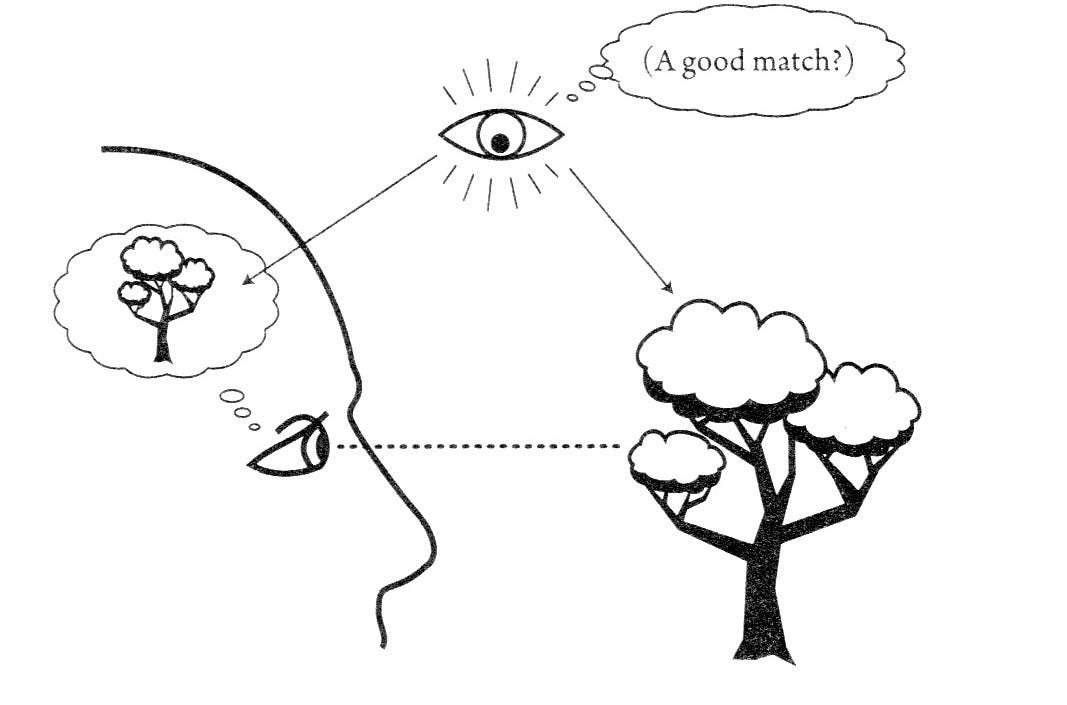
More energy is spent avoiding the problem and gas-lighting students than solving it, as past efforts at proving its existence have been so fruitless.
The belief in this “outer world” has been called “common sense metaphysics.” Yet there is nothing “common” about the claim that we don’t see the real world.
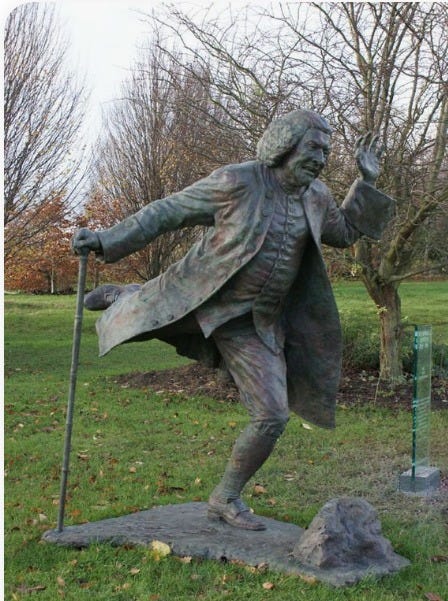
People have been so confused by objections to the existence of the outer world, that they have taken to kicking rocks and waving their hands in the air to prove its existence.1
There’s nothing intuitive about the idea that we can’t see the real world.
There’s no empirical evidence that we can’t see the real world.
There’s no deductive, inductive, or abductive argument that we can’t see the real world.
Kicking a rock does not establish the existence of a second unseen outer world.
Waving one’s hand in the air in front of others does not prove the existence of an external world.
The concept of an evolution of perception simply begins on the premise that our shared experience of things around us is those objects — and proceeds to posit an evolutionary process involving experience to explain it.
Now this current paper is titled “Evidence.” What evidence do you have that you are experiencing things? You don’t need any evidence, because the very fact that you are experiencing this essay right now stands as proof that you are experiencing it — and hence that experience occurs. In fact, the fact that we are experiencing is the only truly self-evident fact we have, as its very factuality is its own infallible evidence. The proof of X is X. X. Therefore, X.
That things in a complex state evolved from things in a simpler state is the best explanation for current conditions is born out by virtually every field of contemporary science which has adopted this approach to explanation. So the fruitfulness of this new approach to explaining things in the sciences is evidence that it might be true of experience as well.
So, beginning with the premise that the idea of an evolution of perception is a plausible explanation for our current experience, I then use abduction, taking the dynamics of our current perception that we know about, especially from gestalt psychology, and propose a best explanation. I then test that explanation for its logical consistency, explanatory power, and parsimony, which are the three main qualities science looks for to choose best explanations.
If you have read this far, found this interesting, and would like to read further, all my books, papers, and videos are linked to from my website Chris Ott Hub, which you can link to here.
Samuel Johnson once famously kicked a rock to disprove George Berkeley’s claim that our shared experience of things is what is real. And G. E. Moore described waving his hands before a class in his essay “Proof of an External World,” 1939.